Mr. John Thorpe is a student of Mr. Richard Matthews. Mr. Richard had the privilege of meeting H.H. Mahatapasvi Shri Kumarswamiji at the Yoga and Spiritual Center of Mr. Peter Rendel in England in 1976. Mr. John has described his experiences of practising Shiva-yoga in his own words.
Shiva Yoga has had a profound effect upon my life. Like a key that fits a lock, it has opened up a new dimension of thought and perception whilst turning my life inside out. To a certain degree, it has enabled me to know myself and embrace the spiritual reality of life. It is a path for those who want to know themselves and find the deepest spiritual knowledge. It enables inner self-transformation, a spiritual alchemy. Old and limited patterns of emotions and thought are transformed into ever-new and more flexible patterns, raising them to the highest possible degree within our temperament and abilities at a particular time.
Shiva Yoga enables us to tune in to our inner "Self", opening us to a deeper experience and knowledge of the "universal" and even beyond, to its transcendent "Ground". Before I became acquainted with Shiva Yoga, I began practising Hatha Yoga at the age of 20, though my understanding of it was rather limited. I saw it only as a series of postures for health and did not realise its spiritual significance.
As the years passed, I read some books on Eastern thought and spirituality. At the age of 23, I read a book called "Wisdom of the Ancients", which encouraged me to practise breathing and meditative exercises. After a few weeks, I had some interesting experiences. An "inner door" opened in my mind, and I experienced intense colours, particularly blue.
What did all this mean? I certainly got a buzz from it and was feeling rather good until I had a "bad" experience that made me rethink what I was doing. One day, I had a more oppressive experience: I saw mask-like faces that seemed to press in on me from all sides. They were not outside me but within my own consciousness, and the whole experience frightened me. When the experience recurred, I gave up the meditation and breathing exercises, as I knew it was somehow linked to them. After giving them up, everything returned to "normal". Thank God!
At this point in my life, I felt frustrated because I wanted those pleasant experiences but did not really know what I was tampering with inside myself. I read the words in the book that said, "When the pupil is ready, the master appears." This was not what I wanted to hear because I wanted the teacher here and now, at the age of 23. I did not want to wait. I knew I needed an experienced spiritual teacher to help me through meditation practice.
A few years and books later, I found myself becoming more interested in spirituality, philosophy, psychology and self-development. However, it was not until I moved to Cornwall that I met my Yoga teacher, Richard Matthews. It was now 1990, and I remembered the book that said when the pupil is ready, the teacher appears. Well, this was it! I was now 30 and ready to start something new and exciting—Shiva Yoga. I had never heard of Shiva Yoga before, but I was keen to be initiated and begin practising, as I had waited long enough for this to happen.
I feel fortunate to have met Richard Matthews. He spent 11 months with Kumaraswamiji on his first visit to Tapovan Ashram in India, three months on his second visit and six weeks on his third. Kumaraswamiji is a master of Shiva Yoga. Richard is very experienced, with at least 30 years of Shiva Yoga meditation. He is a disciple of Kumaraswamiji, who trained him at Tapovan Ashram in India so that he could bring the teachings and practice of Shiva Yoga to the West.
Undoubtedly, an experienced and sincere teacher is invaluable in the pursuit of one's spiritual knowledge and development. A master or teacher of Yoga should act as a catalyst to awaken the inner potential, experience and knowledge that exist within us. Nothing should be accepted on mere trust, and the process is not bound by belief. Yoga is not a dogma, creed or religion. The teacher helps the pupil find the answers within themselves. The power and effectiveness of Shiva Yoga come through meditation practice.
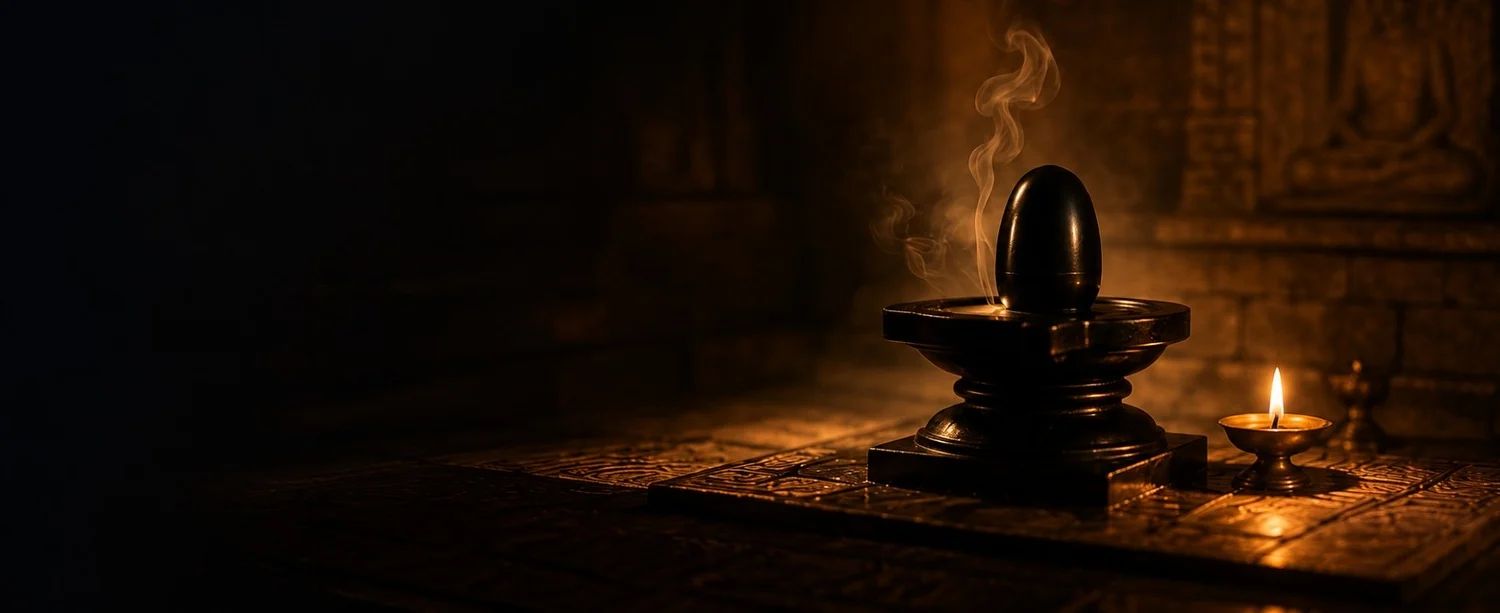
The method and technique of Shiva Yoga are simple. All that is required is a darkened room, an oil lamp or candle, a silk cloth and a "Linga" (Ishtalinga, one worn on the body). The oil lamp is placed behind the left shoulder so that a speck of light is reflected in the Linga, which is placed upon the palm of the left hand at eyebrow level.
Ishtalinga is a small, cone-shaped stone made from light-grey slate and coated with a fine, durable paste prepared from certain ingredients. The colour of the paste is blue-black or indigo, which is also the colour of the Ajna Chakra. During meditation, these two act and react upon each other, enriching intuitive power.
In Yoga, there are said to be seven chakras located in the human etheric body. The Ajna Chakra is the sixth, located at the centre between the eyebrows, otherwise called the brow chakra. Intense gazing at the Linga while repeating Om Namah Shivaya, a mantra, stimulates the chakras and particularly the dormant pineal gland, awakening intuitive awareness and self-knowledge. It is an awakening of the "inner" eye, otherwise known as the Third Eye, as described by Kumaraswamiji.
As a result of sustained looking at the Linga, the transmuted energies rise through the nerve channel into the medulla oblongata (midbrain), through the pons, and then pass down into the pituitary behind the eyes. The increasing pituitary radiations finally pass through the third ventricle in the brain until they awaken the dormant pineal gland and the Third Eye lights up between them.
The meditation process is really like a mirror. It has enabled me to see myself as I am rather than as I would like to be. When I look in an ordinary mirror, I see a physical body or appearance. In meditation, I am able to "see" beyond my mere appearance. In other words, I have turned my gaze inward upon myself to discover the truth and reality about myself. I have searched for the truth about life and myself for many years, and Shiva Yoga has indeed fulfilled my aspirations to the point of no return.
Certain emotional and mental blocks have been freed through this cathartic process. In fact, the practice has given me a greater understanding of myself, both emotionally and mentally.
In the pursuit of the spiritual through Shiva Yoga, it has helped me grow as a human being, which has been an important basis for further spiritual development. It has helped me become aware of various hindrances and negative effects of my past. Like ghosts, they hang around, clouding the future. They are therefore exorcised through Yoga practice, letting in more light and giving an inner sense of freedom.
When I first began practising Shiva Yoga, I was full of expectations: heightened consciousness, self-knowledge, and an understanding of life, the universe and everything were on my list. My head was certainly in the stars as I aimed high. However, I did not realise that I was in for a bumpy ride.
I had the idea that by practising Yoga I would soon realise the promised peace and tranquillity, along with the knowledge and wonderful experiences that come with them. This was what I wanted and how I wanted to be. I could almost pretend I was already there, though inwardly I knew the truth.
At first, there was a shock to my system. After months of practice without really getting what I was after, my enthusiasm swung from "I can do it" to "No, I can't", and from feeling inspired to finding meditation difficult. I managed to continue practising, sometimes thinking of it simply as preparation for what was to come. I did not expect it to be so difficult and wondered whether it would work for me. I did not even know how I would recognise that something had happened. I wondered how I might know something inwardly through a deeper experience rather than remaining on the surface. Blazing lights and something dramatic would have done nicely, but that would have missed the point.
I remember asking Richard, "How will I know when I have such a spiritual experience?" This may seem a daft question, but to me it was unknown territory. Although I expected "things" to happen, I did not really understand what to expect. Richard simply said, "Like a fish that bites at the end of a fishing line, you will know it."
So it was back to meditation. Now, after 16 years of practice, I realise the significance of meditation. What I thought or expected from Shiva Yoga has turned out differently. Instead of glamorous experiences, I began to recognise my own pain and suffering, which are well noted in Buddhism. This was not really what I wanted to see, but I had to see it because it was true. It can be difficult to look within oneself and see the truth. It is no wonder that many people give up meditation when faced with such inner reality.
However, as Kumaraswamiji points out, pain and suffering are not the final word. The final word is nothing less than a state of Being, consciousness and bliss (Sat, Chit and Ananda). There have been times when I could have given up, because Satchitananda was not what I experienced. Over the years, however, I have found a new self-awareness that has helped me see things as they are.
Meditation has enabled me to face myself instead of escaping my problems. I now begin to understand what those oppressive, mask-like faces meant all those years ago when I started breathing meditation. In one sense, they signified being prepared for the unknown; in another, they symbolised both fear and "darkness". If we are spiritually illumined, there is no darkness, but I was only a beginner.
Through Shiva Yoga practice, a dawning of consciousness occurred within me. It was subtle yet extraordinary. It is a light cast upon both the emotions and the mind. The mind, like the moon, is always capable of absorbing more light. The more light it receives, the less fixed and rigid it becomes. Thus, we can soar to great heights while delving deep within. Such new awareness or illumination helps us see what we need to see.
If there are problems or issues to be dealt with, then that is what we must do. By accepting ourselves in both our positive and negative aspects, rather than rejecting the negative parts, our consciousness or interior reality can be transformed into something higher and more spiritual.
With great difficulty at first, I have learned to accept myself in both my strengths and weaknesses, both the positive and the negative. If negative emotions or thoughts prevent us from looking within ourselves, we remain stuck until we have the courage to face them.
We can try to hide certain aspects of ourselves from others, but we can never really fool our true self. Meditation is therefore an opening-up process. It has certainly helped me develop greater sympathy for others and become more accepting of them. This whole process can turn our world completely inside out, as we begin to see from within rather than at a superficial level from without.
Hence, it is nothing less than profound. This inner seeing is the awakening of the Third Eye. It is possible to understand our past and glimpse the future. When we learn to see things as they are, we can look beyond appearances and intuit the reality behind things and ourselves. As Kumaraswamiji says, "The real hides behind the apparent and the apparent masquerades as the real."
The real hides behind the apparent and the apparent masquerades as the real.
Shiva Yoga takes us into the centre of our own being. The further inward we go, the more light we find—the light of our soul. This is where we find illumination. It seems absurd that humankind seeks pleasure and power through matter, the material world and all its delights, when these are no more than fool's gold.
Enjoyment of material things is not the problem. The problem arises when material enjoyment becomes the be-all and end-all, as it seems to for many people in a consumerist, materialistic world. Material things are ephemeral; they do not last. Everything on this planet is born and dies. The enduring substance is that which has a spiritual basis, or values supported by that basis.
The soul or spirit is the permanent principle within us and all things. It is the secret connection between all beings, the light that guides and transforms us. If our spiritual consciousness burns dimly, like a darkened room, it is possible to awaken it through Yoga practice.
Shiva Yoga is not a quick fix. It takes years to put the basics in place, and impatience only sets back that goal. My own impatience has been thoroughly challenged, and I am still learning this basic fact. However, the rewards of such effort cannot be underestimated, as we acquire greater self-understanding and find our way in life.
Sincerity is an important aspect of Yoga practice, because we are searching for higher consciousness and power within ourselves rather than making our human ego more powerful. In this way, we can use our developed abilities for the good of ourselves and others and develop a little compassion. As Kumaraswamiji says, be good and do good. Shiva Yoga does bring greater powers of perception and intuition, but it is unwise to yearn for powers that only enlarge one's ego—which is egoism.
Shiva Yoga is a path that can put us in touch with ourselves and ultimate reality. The Yogi Adepts teach that there is a divine spark in all of us and that it is possible to realise it. This Spark or Soul (Sharana) is one with the Universal Divine (Shakti). Beyond this Cosmic Divine exists the ultimate Ground of all existence: the Transcendent Divine (Shiva). Shiva Yoga provides us with the marvellous challenge of experiencing this universal and transcendent spirit that exists within.
From a historical point of view, Shiva Yoga is an ancient practice or spiritual discipline. In the ancient Indus Valley of India, at Mohenjo-daro, around 5,000 years ago, there are signs associated with Shiva Yoga in the form of various conical stones (Ishtalingas) found there along with other artefacts. In his book, "Technique of Opening the Third Eye", Kumaraswamiji explains the links between various artefacts found in the Indus Valley and their relationship to Shiva Yoga.
What I have learnt from the practical aspects and teachings of Shiva Yoga is that inner seeing and transformation are not only possible but real. It is a technique that enables us to experience change. This does not mean changing into something other than what we are; rather, it enables transformation into what we truly are.
In other words, we begin to learn more about ourselves, our feelings, our minds and what lies behind them. We cannot become something entirely different from what we are, but we can realise what we are, both in potential as human individuals and as spiritual or cosmic beings.
Instead of our outer life changing first, we begin to see what we really are, and from here our view of life changes. If we look at life from the bottom of a mountain, we can see only the surrounding hillsides. As we rise further up the mountain, our view expands and we can see things that were hidden before. If we reach the top, we can see all around and below us; we therefore have an enlightened view.
There may be different paths up the mountain, but the view from the top is the same. As we develop spiritually, our view of life inevitably becomes greater. We can see more clearly and understand things that were hidden from us. From this perspective, it becomes easier to accept our limitations while also recognising our potential.